
The Convergence of Sustainability, EHS, and Risk Management
For many years, sustainability, Environment, Health & Safety (EHS), and risk management lived in separate silos. Different teams, different tools, different priorities. Today, that separation is becoming harder—and riskier—to maintain. Organizations are increasingly realizing that sustainability, EHS, and risk management are not parallel functions. They are deeply interconnected systems that influence the same outcomes: operational resilience, regulatory compliance, and long-term value […]
CSRD in 2025: What Changed, Why It Matters, and What Companies Should Do Next
The Corporate Sustainability Reporting Directive (CSRD) has been one of the European Union’s most ambitious attempts to reshape sustainability transparency. Designed as the successor to the Non-Financial Reporting Directive (NFRD), CSRD aims to bring ESG reporting onto the same footing as financial reporting—standardized, comparable, and data-driven. At its core, the directive requires companies to disclose […]
The ROI of Sustainability: What Research Really Shows
For years, sustainability was treated as a feel-good initiative—good for society. Today, the conversation has shifted. Leadership teams, investors, and even regulators are asking a more practical question: “What’s the actual return on investment (ROI) of sustainability?” It’s a fair question. With rising expectations around ESG reporting, carbon reduction, and ethical practices, businesses want to know […]
How to Obtain SBTi Validation: A step towards Science-Based Climate Action
As climate expectations from investors, customers, and regulators continue to rise, organizations are increasingly seeking credible ways to demonstrate genuine progress toward decarbonization. The Science Based Targets initiative (SBTi) has emerged as the leading global framework for setting emissions-reduction targets aligned with the 1.5°C pathway. Achieving SBTi validation signals that a company is not only committed to climate leadership but is […]
The EU’s Carbon Border Adjustment Mechanism (CBAM): What Indian Exporters Need to Know
If you’re an Indian exporter, you’ve likely heard about the European Union’s Carbon Border Adjustment Mechanism (CBAM) — a policy that’s set to reshape global trade dynamics in the coming years. But what does it really mean, and how could it impact your business? At its core, CBAM is the EU’s way of ensuring that imported goods are subject to the same carbon costs as those […]
Why ESG Is More Than a Trend — It’s a Business Imperative
In today’s rapidly evolving business landscape, ESG — Environmental, Social, and Governance — is no longer just a trend. It’s a strategic responsibility and a powerful driver of long-term value. Companies that embrace ESG aren’t just in compliance with global standards; they’re building resilient, future-ready organizations that appeal to investors, customers, and employees alike. ESG […]
OSHA’s HazCom Update: Aligning Standards with GHS Revision 7
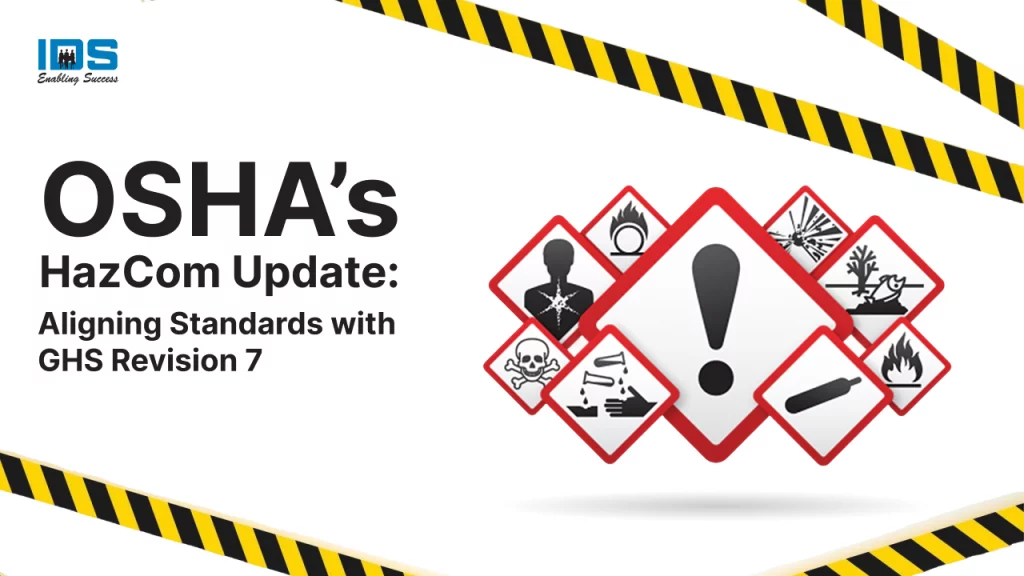
OSHA has rolled-out its long-awaited update to the Hazard Communication Standard, bringing it in line with GHS Revision 7. This update introduces key changes that manufacturers, importers, and distributors need to understand to stay compliant. In this article, we’ll cover the key updates and what businesses need to do to ensure compliance. What is the […]
GPSR Compliance: Key Changes and Responsibilities for Businesses
GPSR covers all non-food products sold in the EU, including items that are used, repaired, or refurbished, through any sales channel. Scope GPSR covers all non-food products sold in the EU, including items that are used, repaired, or refurbished, through any sales channel. Key Objectives Ensure only safe products reach consumers by addressing regulatory […]
EPA’s 2025 TSCA Inventory Update: Key Changes and Compliance Tips
In January 2025, the @U.S. Environmental Protection Agency (EPA) rolled out an updated version of the Toxic Substances Control Act (TSCA) Inventory. It covers the chemical substances that are: Manufactured Processed, or Imported in the U.S. under TSCA, that do not otherwise qualify for an exemption or exclusion Key highlights of the 2025 TSCA Inventory […]